
Last updated September 20, 2026
Free on-site gate assessment - hinges, posts, and your LiftMaster or Nice gate operator checked before anything is quoted
The assessment is free and the quote is the invoice.

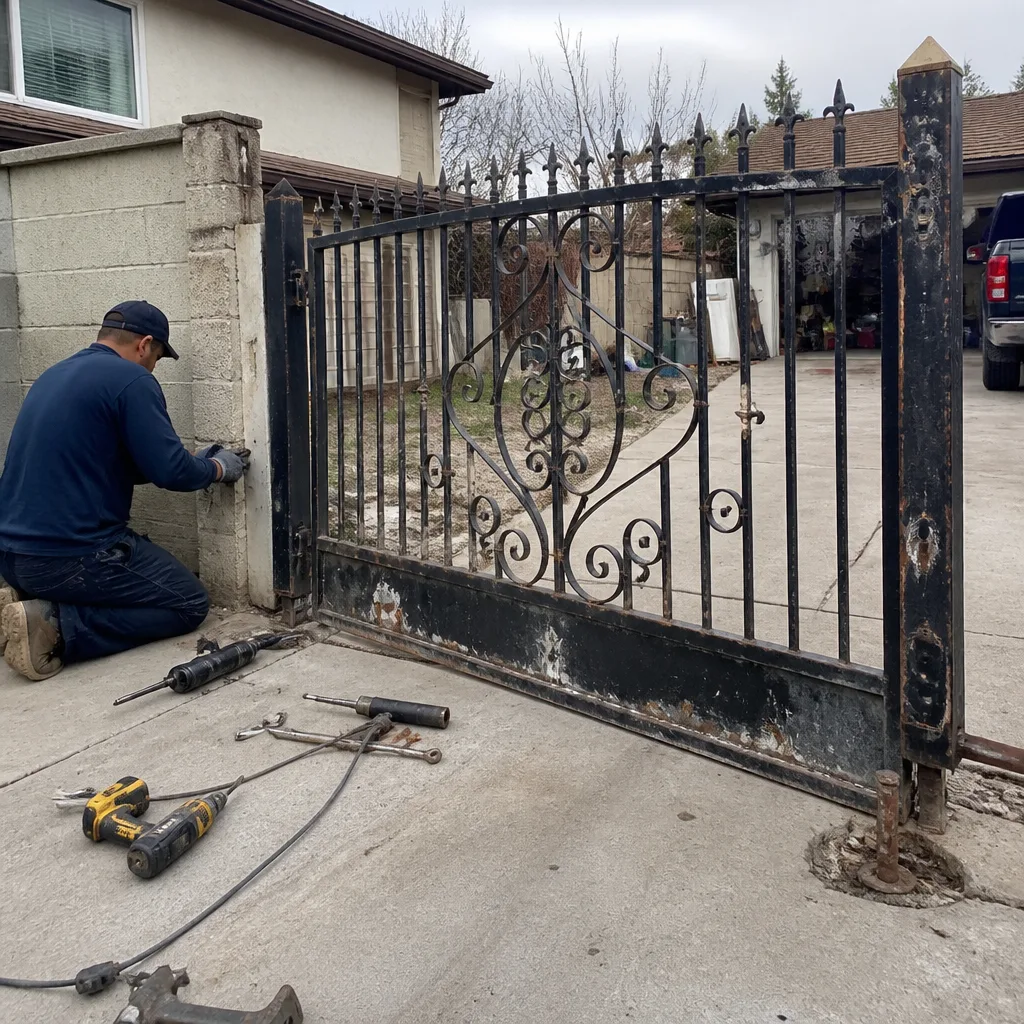 Before
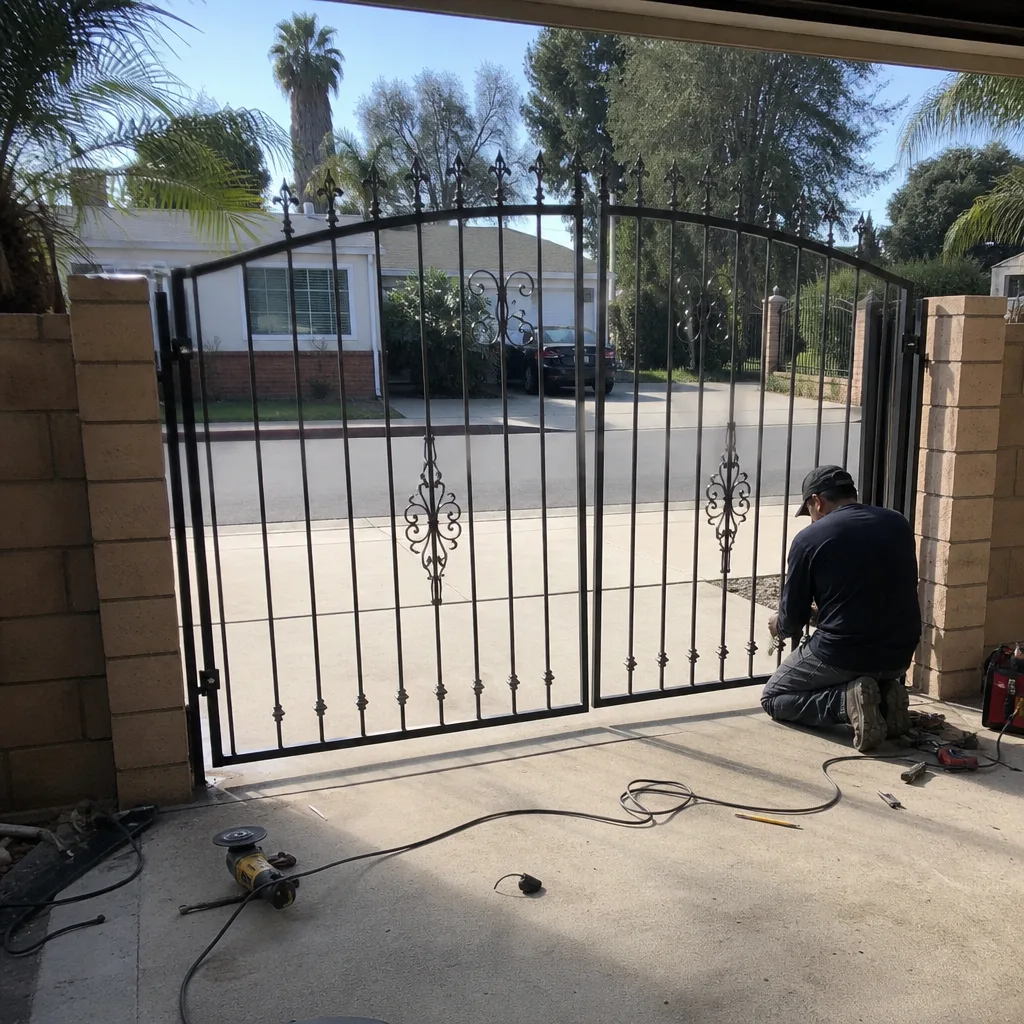 After
After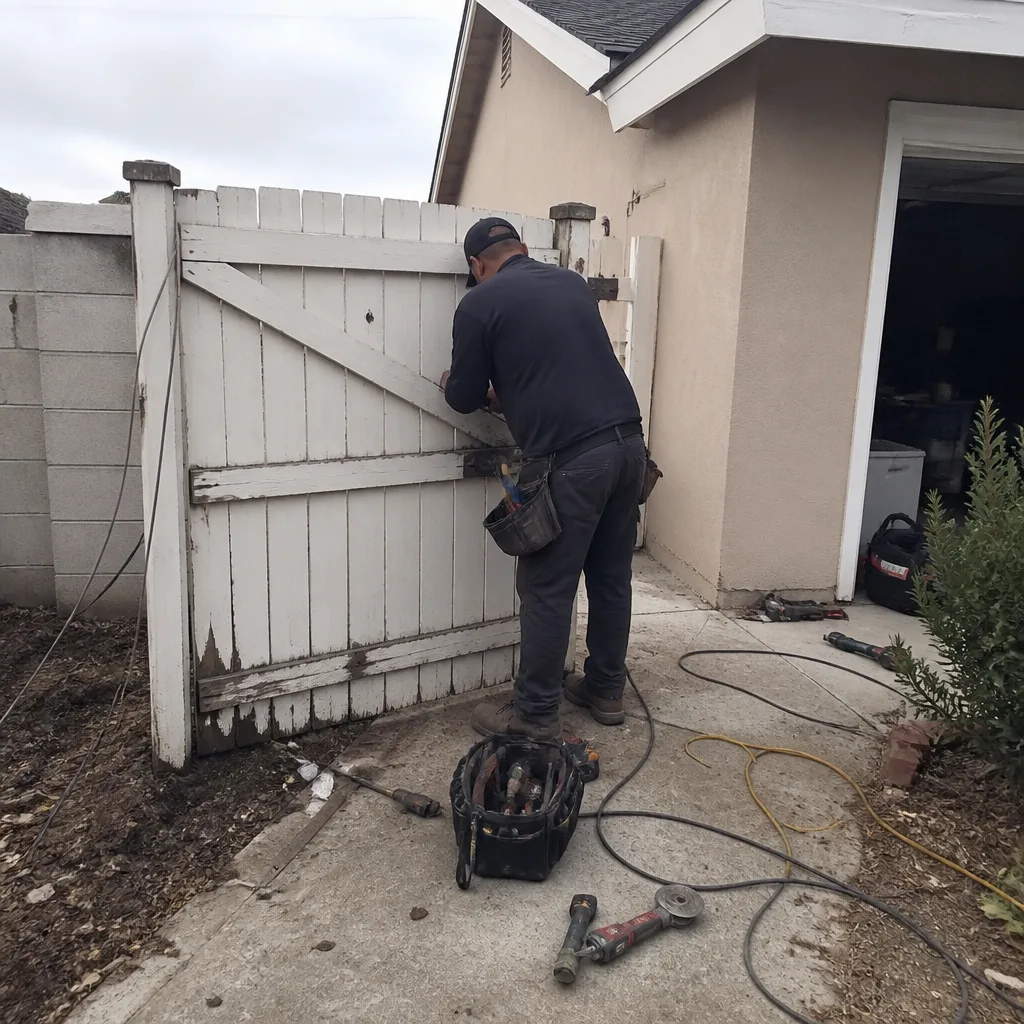 Before
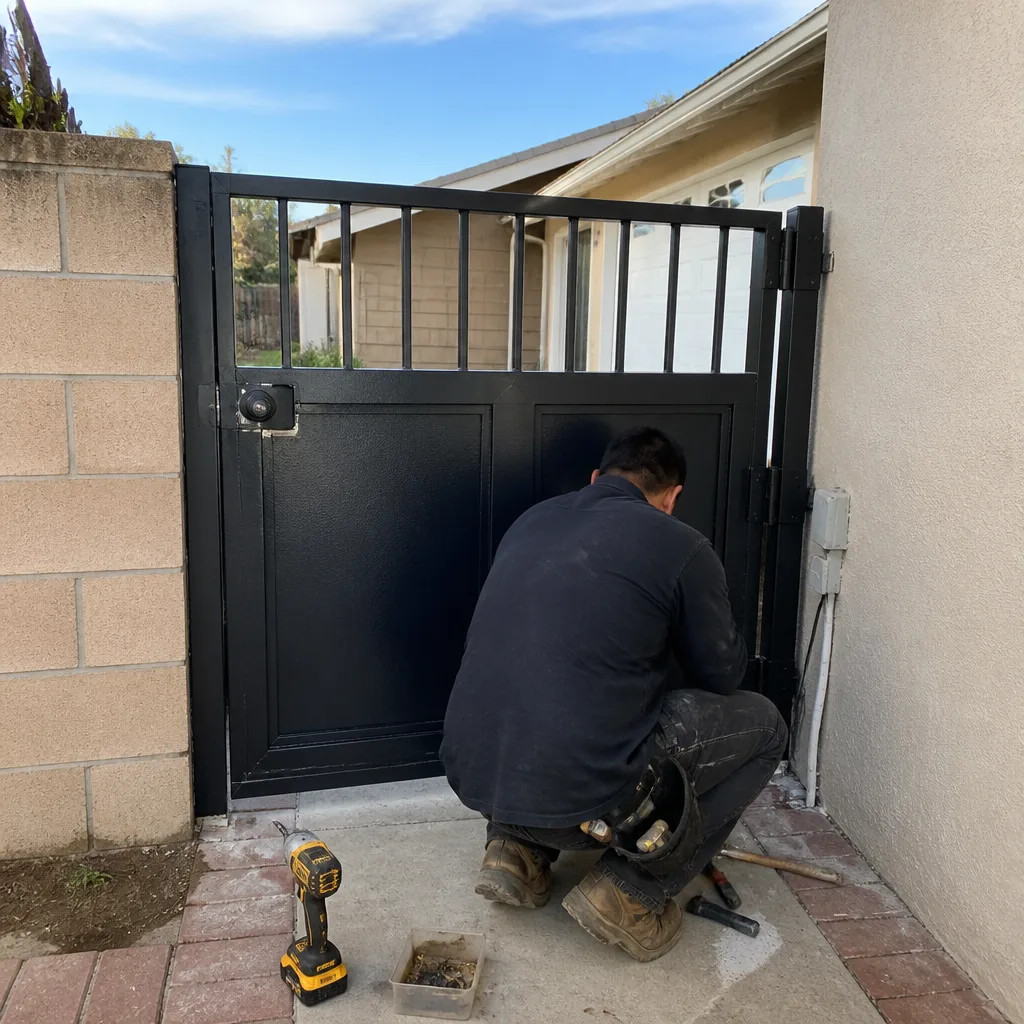 After
After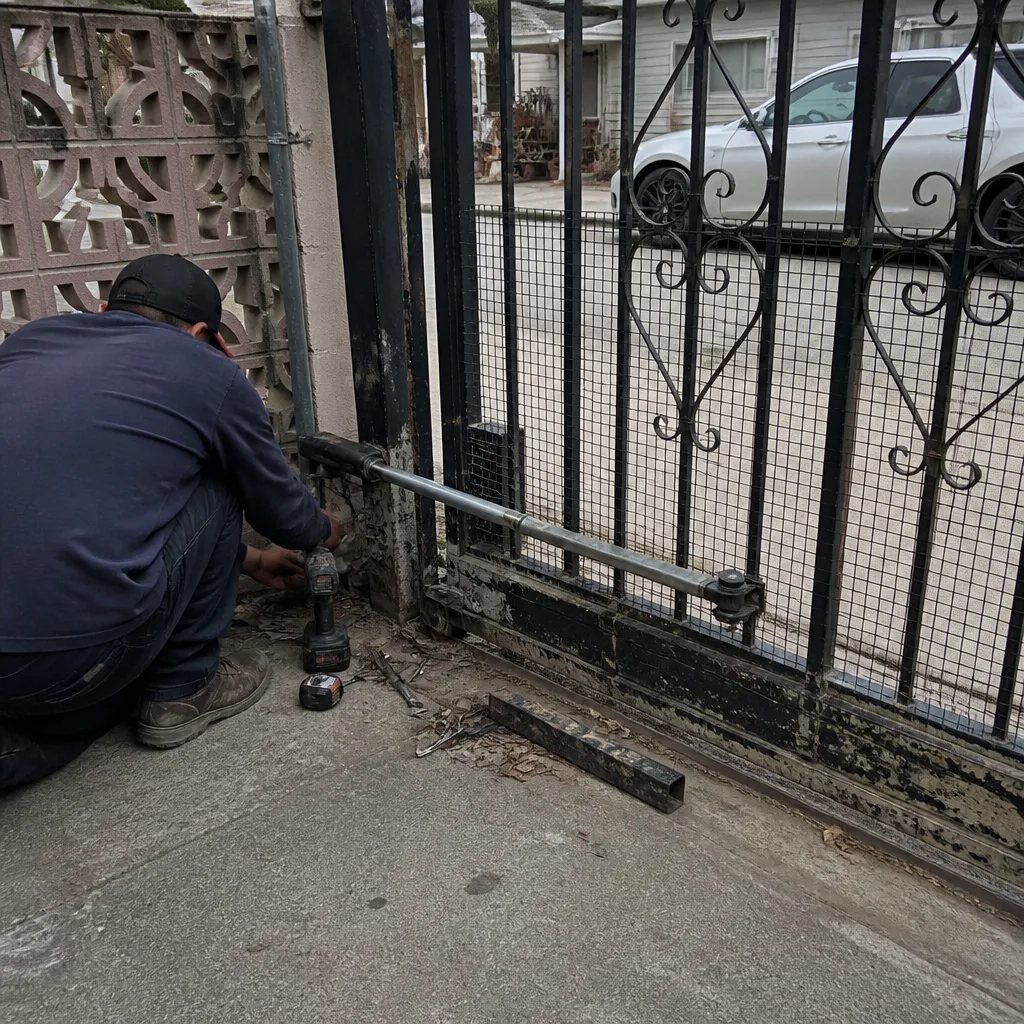 Before
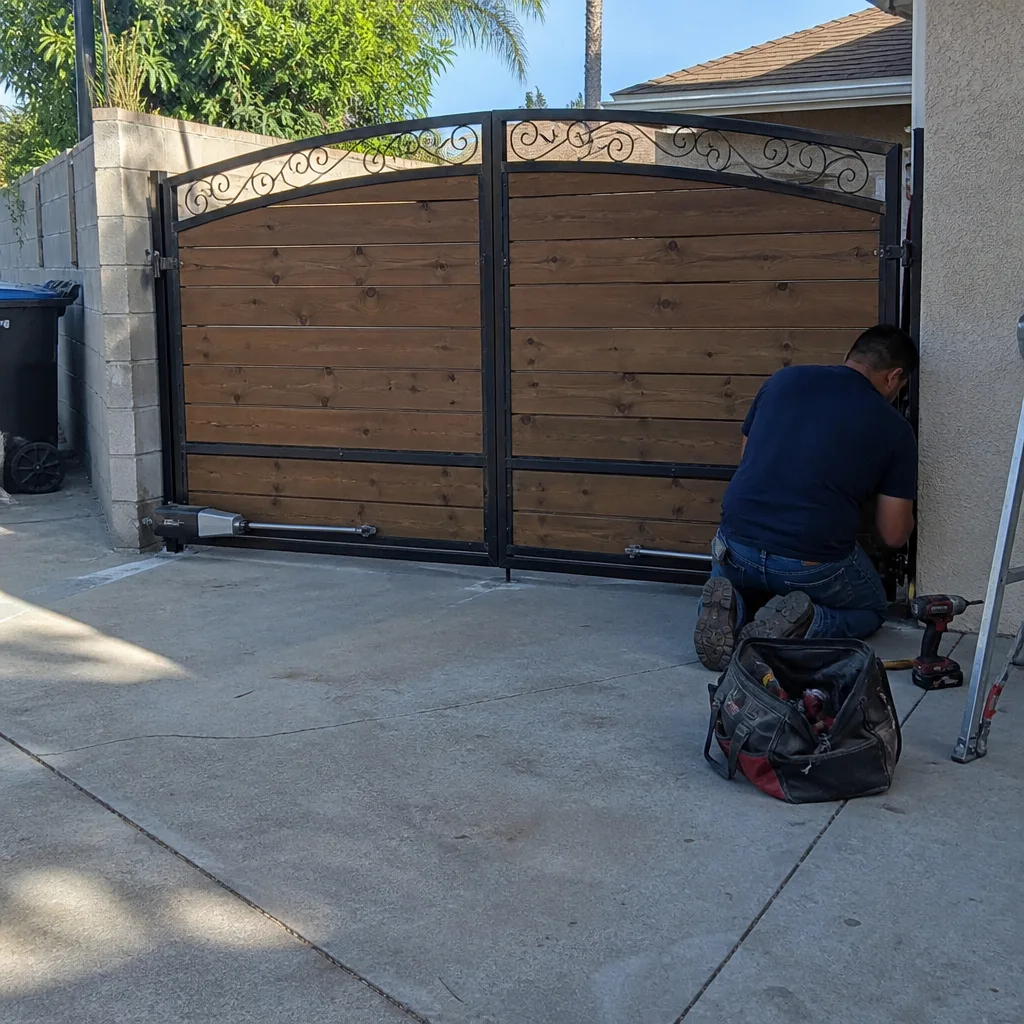 After
AfterGate Repair Permits, Codes & Inspections in CA: What You Need to Know
Replacing a failed gate operator with an identical model almost never needs a permit. Adding one to a gate that never had one almost always does. Most homeowners don’t know which situation they’re in until the work is done, and by then the distinction has already shaped their title history, their insurance file, and their liability if a child or a delivery driver is ever injured by the gate. This guide draws the line precisely, using Anaheim’s Building Division rules as the reference point, because Anaheim is where we work and where we see the same three permit mistakes repeated across neighborhoods from the Colony to Anaheim Hills. For Gate Repair Warning Signs: A Anaheim Homeowner’s Reference Guide, see our dedicated post.
Quick Answer
In California, routine gate repair, like replacing a motor, hinge, wheel, or circuit board with a matching part, is treated as maintenance and requires no building permit. You need a permit when the work changes the footprint, structure, or powered equipment in a substantial way: altering the gate frame, pouring new footings, adding an operator to a gate that never had one, or changing the gate’s size, height, or swing direction. In Anaheim, the City of Anaheim Building Division applies these thresholds through the California Building Code and the California Residential Code, and a few gate projects also trigger UL 325 entrapment-protection requirements that a permit inspector will check.
Table of Contents
- Repair vs. Replacement vs. New Installation: The Scope Thresholds
- UL 325 and Entrapment Protection: What California Code Actually Requires
- The Anaheim Permit Process for Gate Work: Steps, Time, Cost
- Unpermitted Gate Work and Title Searches: What Escrow Reveals
- HOA Overlay: When Anaheim HOA Standards and City Code Conflict
- Insurance and Liability: What Your Gate’s Documentation Has to Prove
- What a Post-Job Documentation Record Should Contain
- Common Mistakes to Avoid
- When to Call a Professional
- Frequently Asked Questions
- The Bottom Line
BeforeAfterRepair vs. Replacement vs. New Installation: The Scope Thresholds
California draws the permit line by asking one question: does the work restore the gate to its previous condition, or does it change the gate? Restoration is repair. Change is alteration, and alteration triggers review. The California Residential Code, which Anaheim has adopted with local amendments, exempts ordinary maintenance from permit requirements, and ordinary maintenance includes replacing a worn part with a comparable part. A gate that swings on failing hinges gets new hinges. A sliding gate with a dead capacitor gets a new capacitor. A broken wheel carriage gets a new carriage. None of this requires a permit because none of it changes what the gate is.
The threshold moves when the work crosses into structural or operational change. In Anaheim, these are the gate projects that require a building permit:
- Adding a gate operator to a gate that was manually operated. The moment a motor gets mounted and a control box gets wired, the gate becomes a machine, and machines are regulated equipment under the California Electrical Code. This is the most commonly skipped permit in Anaheim residential gate work.
- Changing the gate’s physical dimensions or swing direction. A taller gate, a wider gate, a gate that used to open inward and now opens outward, a gate moved to a new post: all of this changes load paths, setback distances, and public-right-of-way clearance, and all of it triggers plan review.
- Pouring new concrete for gate posts or a new track. Footings are structural. A new footing means a new foundation element, and foundations are not maintenance.
- Installing a new gate where none existed. This creates a new structure on the property. Even if the gate is purely decorative, it changes the site and needs a permit in Anaheim, particularly if it fronts a public sidewalk or sits within a front-yard setback.
- Replacing an entire gate with one of different construction. A wood gate swapped for a steel gate is not a like-for-like replacement. Materials change, weight changes, and the posts may no longer be adequate. That is an alteration.
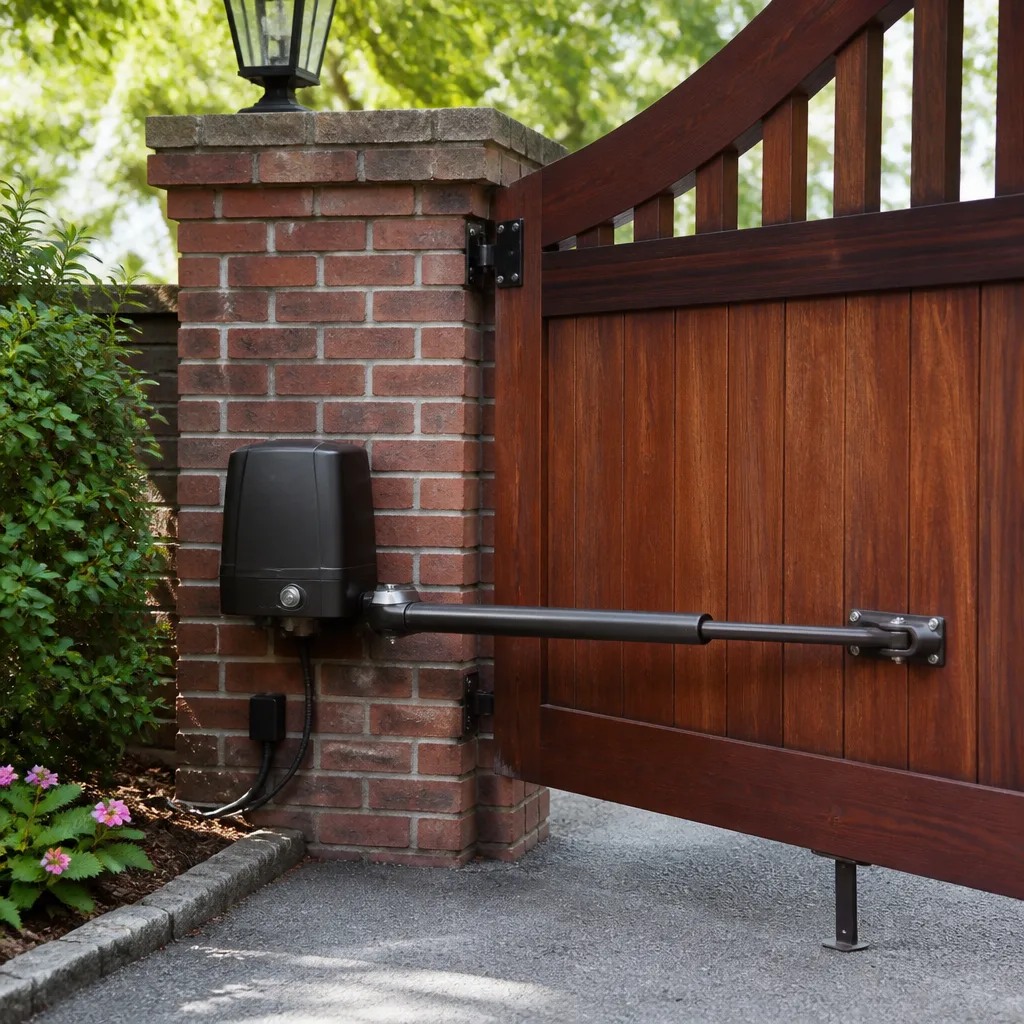
One nuance we see constantly in Anaheim: replacing a failed gate operator with the same model and the same mounting configuration is repair, even though an operator is an electrical device. The California Electrical Code exempts like-for-like equipment replacement from permit requirements as long as the circuit is not altered. Replace a LiftMaster LA400 with another LA400 using the existing conduit and wiring, and no permit is required. Replace a LiftMaster LA400 with a Viking F-1 that uses a different voltage or draws more current, and the circuit may no longer be adequate, which pulls the job back into permit territory. We tell every Anaheim customer the same thing: if the new operator is a different brand or a substantially different model, check the nameplate amperage against the old one before anyone wires it in.
UL 325 and Entrapment Protection: What California Code Actually Requires
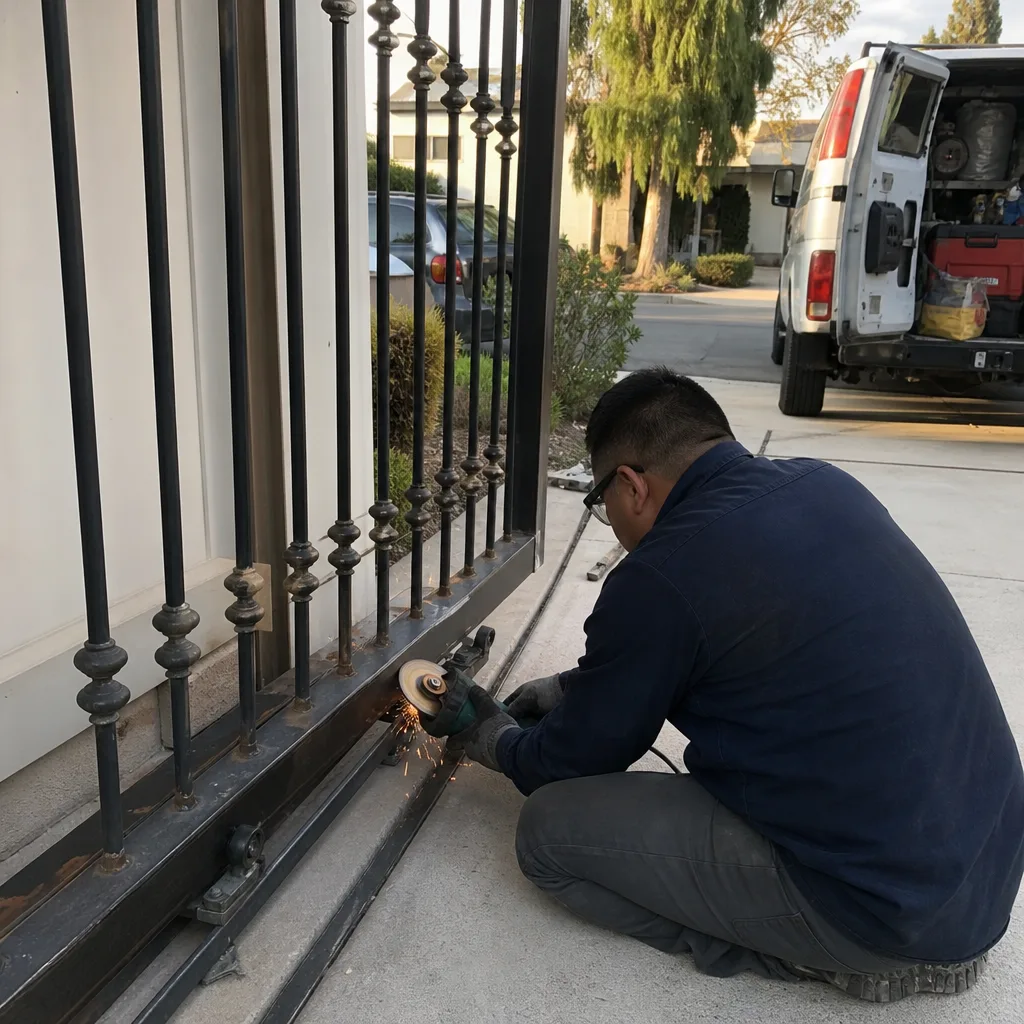
UL 325 is the safety standard for automated gates, and California enforces it through the state’s adoption of the National Electrical Code and the building standards in Title 24. The rule that matters most for homeowners is simple: every automated gate must have at least two independent entrapment-protection devices, and one of them must be an external sensor, like a photo-eye, that monitors the gate’s path and stops the gate if anything breaks the beam.
Here is the configuration chart that determines what a compliant Anaheim gate actually looks like:
- Swing gate, operator with inherent entrapment protection: one external photo-eye or one non-contact edge sensor across the gate’s swing path, plus the operator’s built-in obstruction sensing.
- Slider gate, operator with inherent entrapment protection: photo-eyes on both sides of the gate at the leading edge, plus external safety edges on the leading and trailing edges if the gate closes against a fixed object like a wall or fence within 16 feet.
- Swing or slider, operator without inherent entrapment protection: two external devices minimum, and in most residential configurations, a monitored contact edge (a pressure-sensitive strip that sends a supervisory signal) is required at every pinch point, plus a photo-eye at least 18 inches from the gate face.
- Any gate controlled by a loop detector system that allows automatic closing: the gate must have an audible alarm that sounds before movement begins, in addition to the external sensors.
We would put this more plainly because most homeowners have never read UL 325: any place where a moving gate can trap a hand, a bicycle wheel, or a child between the gate and a fixed object needs a device that reverses the gate before injury. Pinch points are the frame-adjacent gaps. The gap between a swinging gate and its post is a pinch point. The gap between a sliding gate and its fence line is a pinch point. These are the places an inspector will look first, and they are the places a plaintiff’s attorney will measure with a gauge block after an injury.
One Anaheim-specific wrinkle: many homes in the city’s older districts, particularly the pre-1970s neighborhoods around the Colony and the neighborhoods north of Lincoln Avenue, have gates that predate UL 325 entirely. A 1965 swing gate with a 1995 external operator bolted on the side has never met current code. The gate may have functioned for decades without incident, but the liability picture is different now. If that gate injures a visitor in 2025, the absence of modern entrapment protection will be central to the claim, and a homeowner who has documentation showing the gate was assessed, the pinch points were identified, and the gaps were shimmed or the sensors were added is in a materially better position than a homeowner with no records at all. For a full picture of how we handle these older Anaheim installations, see our Gate Repair in Anaheim page.
The Anaheim Permit Process for Gate Work: Steps, Time, Cost
If your project does require a permit, the path through the City of Anaheim Building Division is predictable, as long as you know the sequence. The city runs on a plan-review-then-inspect model, and gate work usually falls under the “small project” or over-the-counter category, depending on the exact scope. Here is the step-by-step process we follow when we pull permits for Anaheim gate installations and operator additions:
- Determine the permit type. A simple operator addition to a single-family residential gate typically falls under a residential combination permit. A new gate with new footings may require a separate building permit and sometimes a zoning clearance if the gate fronts a public street. We verify with the Building Division counter or the city’s online portal before drafting anything.
- Prepare a simple plan set. For most residential gate jobs, Anaheim accepts a site sketch showing the gate location, the setback distance from the property line, the gate height and width, and the operator manufacturer and model. Three pages is usually enough. The city wants to see the location relative to the public right-of-way and the plot plan.
- Submit with the current fee schedule. Anaheim’s permit fees are calculated from the project valuation. A straightforward operator addition typically lands in the $200 to $500 permit fee range for residential work, plus any plan review surcharges. We provide a written line-item estimate before any permit is pulled, so the permit cost is visible on the page, not discovered at the end.
- Plan review and corrections. Most gate permits clear plan review within one to two weeks in Anaheim. Corrections are usually minor: a missing UL 325 specification note or an incomplete electrical detail. We respond to corrections the same day we receive them.
- Rough inspection. For gate work with new footings, the inspector checks the post depth, the concrete pour, and the grounding electrode before anything is covered. In Anaheim, gate posts generally need to be set at least 18 inches deep for a 6-foot gate, with more depth for taller or heavier gates, and the inspector verifies the hole before the pour.
- Final inspection. The inspector verifies the entrapment-protection devices, the warning signage required by UL 325 (the “Moving Gate” signs), the operator’s manual release mechanism, and the grounding and bonding. The inspector also confirms vehicle detection loops or edge sensors are functioning and that the gate reverses within two seconds of obstruction.
The whole process, from plan submission to final sign-off, typically takes three to five weeks in Anaheim for a permit-required gate project, excluding any HOA review period. That timeline matters for anyone planning to sell a property or resolve an escrow condition, which brings us to the part most people get wrong.
Unpermitted Gate Work and Title Searches: What Escrow Reveals
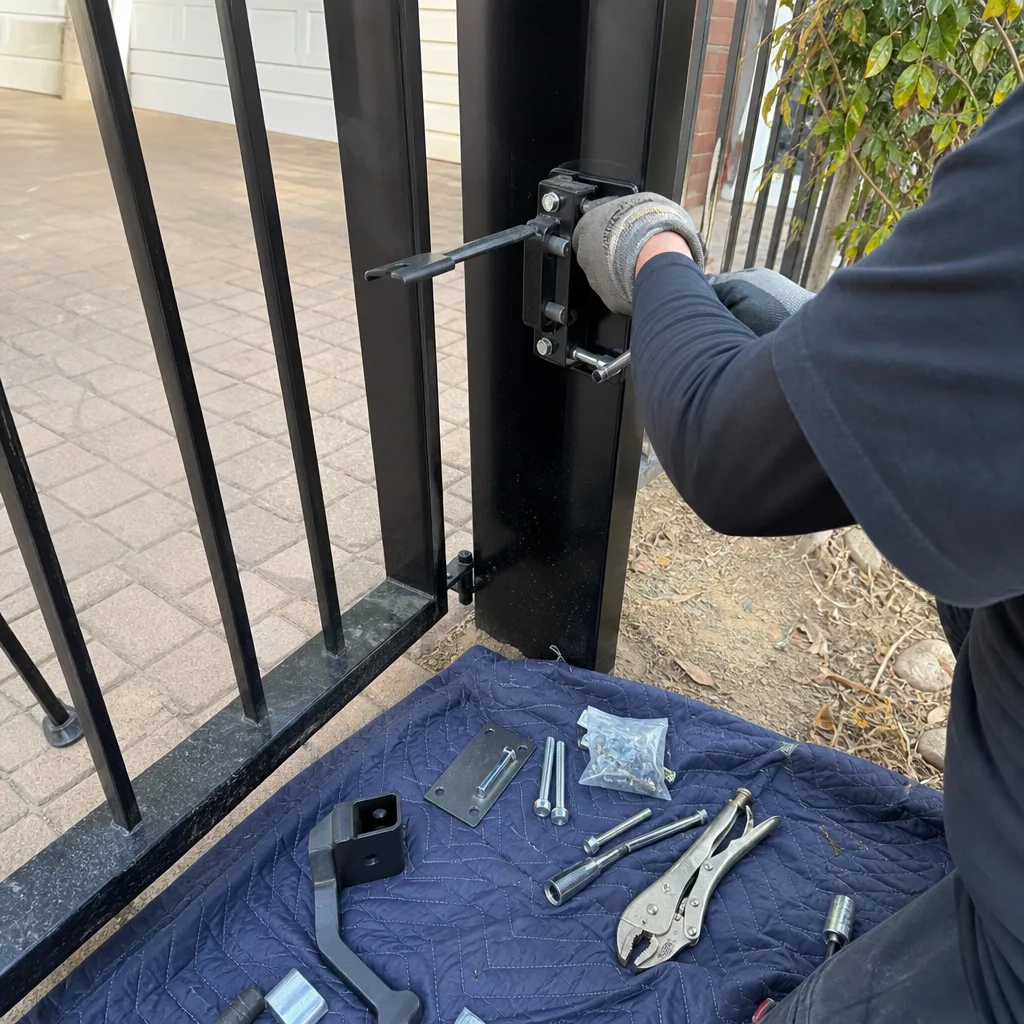
Unpermitted gate work does not show up on a standard title report, because a title search documents ownership and encumbrances, not building history. What shows up is the city’s permit database, and that is where Anaheim escrows get complicated. The city indexes building permits by parcel number and address. If a buyer or a buyer’s inspector requests a building records search, which is increasingly standard practice in Anaheim’s competitive real estate market, the absence of a permit for a visible improvement becomes a disclosure issue.
The scenario we see most often works like this: a homeowner added an automated gate in 2018, did not pull a permit, and listed the property in 2025. The buyer’s home inspector notes the gate operator and flags that no permit record exists. The buyer requests a building records search from the City of Anaheim. The search confirms no permit. The buyer now has a choice: ask the seller to retroactively permit the gate, or accept the risk. Most Anaheim buyers ask for the permit, because their lender or insurer will ask about the gate’s code status, and the retro permit process is the same scope of work as a new permit, except now it is happening inside a closing window.
What does retroactive permitting cost on an Anaheim timeline? The fee schedule is the same as new work, but the inspection process is often stricter. The city’s plan checker knows the gate has been operating for years, so the inspection includes a more careful look at the entrapment protection, the grounding, and the clearance to the sidewalk. If the gate was installed too close to the property line, or the operator is mounted at the wrong height, the owner may have to relocate equipment, repour a pad, or add sensors before the inspector signs off. In our experience, a gate that was installed without a permit clears a retro permit in Anaheim about 70% of the time without structural changes, and the other 30% requires moving something: a post, a pad, a photo-eye, a control box.
The cost of rectifying unpermitted gate work during escrow is almost always higher than the cost of pulling the original permit. We built our Anaheim gate installation practice around this observation. When you work with Gate Installation in Anaheim, the permit is part of the scope, pulled before the first post hole is dug, with the permit number written on your invoice.
HOA Overlay: When Anaheim HOA Standards and City Code Conflict
Anaheim has one of the highest concentrations of HOA-governed communities in Orange County, from the master-planned neighborhoods in Anaheim Hills to the townhome and condo complexes around the Platinum Triangle. An HOA’s design standards govern aesthetics: gate height, material, color, ornamental style, setback from the HOA’s common wall. City code governs safety and structure: footing depth, entrapment protection, electrical safety, public-right-of-way clearance. When the two standards conflict, the stricter one controls.
Consider the most common conflict we see: an HOA requires a uniform 6-foot steel gate with solid pickets to match the community’s original design, but the gate sits on a corner lot where the City of Anaheim’s sight-triangle ordinance limits fence and gate height within 30 feet of the corner. The HOA’s design standard says one thing; the city’s code says another. The city’s requirement governs in every legal sense, and the HOA cannot lawfully force a member to build something the city has prohibited. The practical solution in these cases is a design variance approved by the HOA’s architectural committee, usually a lower gate in the sight triangle with a screen or wing wall to maintain the visual rhythm.
The reverse conflict also exists. Some Anaheim HOAs prohibit automated gates entirely on single-family properties, either because of noise or because the association’s master insurance excludes gate-related liability. The city does not prohibit an automated gate on a compliant single-family lot. In that case, the HOA’s restriction controls, because it is a private covenant, and the city will not enforce or override it. Before anyone installs or alters a gate in an Anaheim HOA, we always ask for the current architectural guidelines and the meeting minutes from the last design review cycle. One hour of reading at the front end prevents a stop-work letter, a fine, or a forced removal at the back end.
The HOA layer also affects documentation. When we complete a gate repair or installation in an HOA community, the post-job record we leave with the homeowner includes the model numbers of the operator and safety devices, the photo log of all pinch-point clearances, and a written summary of the work that the homeowner can attach to an HOA architectural application or an annual compliance filing. You can see an example of how this documentation habit shapes our Gate Motor & Opener in Anaheim service: every visit ends with a written record, because in an HOA, the record is the defense.
Insurance and Liability: What Your Gate’s Documentation Has to Prove
Homeowner’s insurance treats an automated gate as an attractive nuisance and a premises-liability exposure. The carrier does not care whether your gate was permitted. The carrier cares whether you can demonstrate the gate met the applicable safety standard at the time of the incident. If you cannot, the carrier may still defend the claim, but the settlement picture and your renewal premium will reflect the absence of a code-compliance record.
What does that record need to contain? In our experience, a documentation package that holds up in an Anaheim premises-liability dispute includes:
- Proof of the operator’s UL 325 listing. The manufacturer’s label on the unit, photographed and legible. If the label is faded, the make and model recorded in writing with the serial number.
- Photos of entrapment-protection devices in place. The photo-eyes, the safety edges, the warning signage, each photographed from a distance that shows the device’s location relative to the pinch points.
- Measurement records of pinch-point clearances. A written note that the gap between the gate and the post was measured at, for example, 2.5 inches, with a photo of the measurement.
- The last maintenance date and what was done. A service log with dates, technician names, and the specific adjustments or replaced parts. We leave this on every Anaheim service call as standard practice.
- Permit records or a written determination that no permit was required. If a city inspector reviewed the work, the final inspection card. If no permit was required, a dated written statement from the contractor explaining why, with the code section cited.
The homeowner who has this file is in a materially different position from the homeowner who does not. We have seen Anaheim insurance disputes where a $12,000 claim was resolved without litigation because the homeowner produced a complete documentation record, and we have seen similar disputes balloon because the homeowner produced nothing but a faded invoice for “gate repair.” The documentation is not that expensive to produce; it requires only the habit of insisting on it, which is the entire point of the Haven Standard we apply on every job.
What a Post-Job Documentation Record Should Contain
Here is the practical list we put in front of every Anaheim customer before we leave the property, permit or no permit:
- Written scope of work. A one-page description of what was done, in plain English: “Replaced the failed Viking X-9 control board with a like-model replacement. Resolved limit-switch drift by resetting the close limit 4 degrees before the physical stop. Photographed the new position.”
- Photo log. Before photos of the failed component, after photos of the replacement, photos of every pinch point with measurement notes, photos of the safety devices in their final positions, and a photo of the operator’s UL 325 label.
- Part numbers and serial numbers. Written on the invoice, legibly, so a future technician does not have to disassemble the gate to identify a component.
- Permit status. If a permit was required, the permit number and the inspection outcome. If no permit was required, a dated statement citing the applicable code exemption.
- Safety device test results. A written record that each photo-eye, edge sensor, and reversal mechanism was tested on-site and responded within the required two-second window.
This documentation habit did not start with residential gates. Adrian Vance built it during commercial access-control work, where the site owner’s insurance carrier would not accept an undocumented repair. The habit carried over to the residential side because the liability exposure is the same; only the gate is smaller. We leave this record on every Anaheim job because it is the evidence the homeowner needs if the gate is ever involved in an injury claim, an insurance dispute, or an HOA compliance review.
Common Mistakes to Avoid
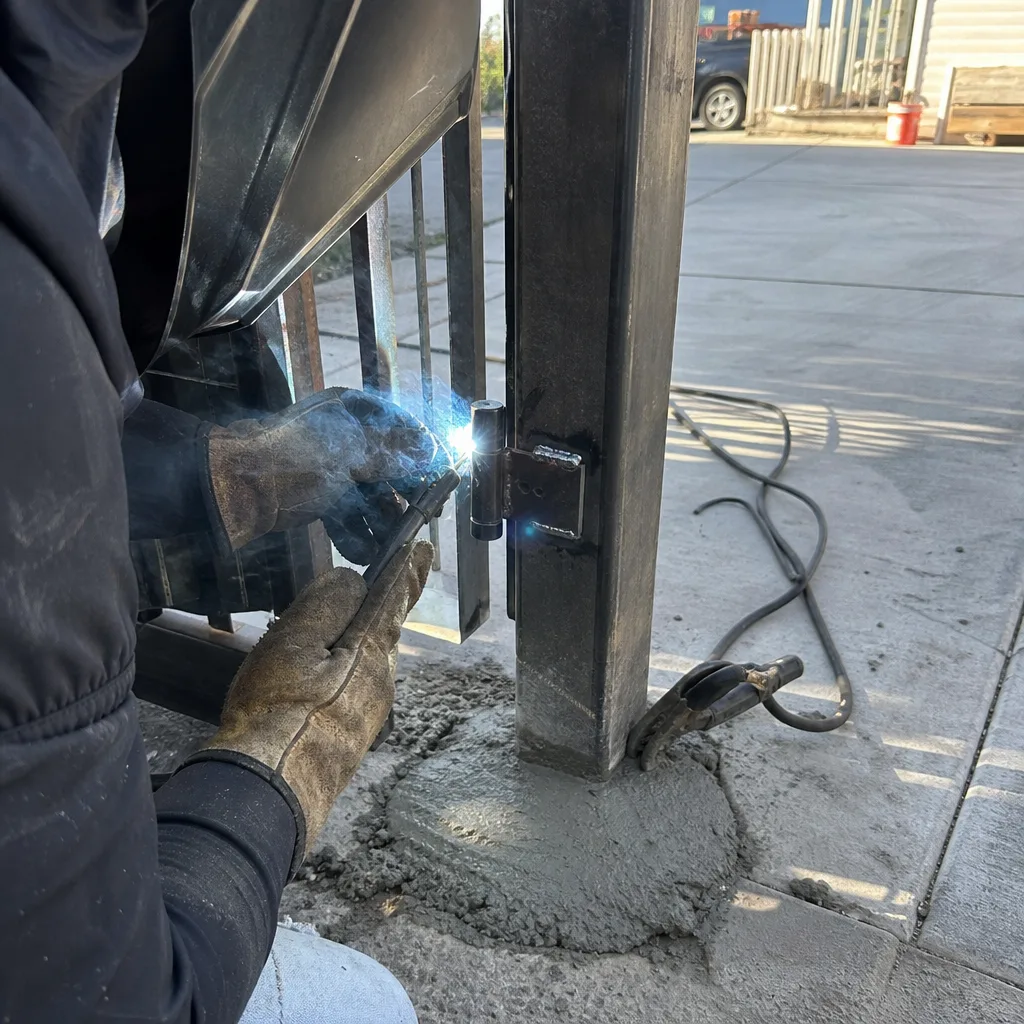
- Treating “adding a motor” as the same as “replacing a motor.” Adding an operator to a previously manual gate is an alteration, not a repair, and in Anaheim it requires a permit. This is the single most common unpermitted gate improvement we encounter.
- Putting a new operator on an old gate without checking the pinch points. A 1980s gate with a 2024 DoorKing operator is still a 1980s gate where the entrapment hazards are concerned. If the gate has gaps larger than current UL 325 allowances at the posts, the new operator magnifies the liability rather than reducing it.
- Skipping the written record. A verbal confirmation that the gate “passed” an inspection is not documentation. If there is no photo and no written note, there is no evidence, and evidence is what your insurer and your buyer will ask for.
- Assuming an HOA approval covers city permit requirements. HOA design approval and City of Anaheim building permits are separate processes with separate authorities. One does not substitute for the other.
- Retrofitting a gate operator on a gate that was never designed to hold one. Not every decorative gate can support a motor, a control box, and the dynamic forces of automated operation. A gate that flexes when a motor pushes it is a gate that will fail early and may injure someone on the way down.
- Waiting until escrow to address a permit gap. The cost of a retro permit during a closing is always higher than the cost of a proactive permit, because the seller is negotiating from a deadline. If you already suspect your gate was installed without a permit, address it before you list the property.
- Using a handyman and a verbal handshake for gate electrical work. A gate operator is a line-voltage device with entrapment-protection logic. The California Electrical Code and UL 325 apply regardless of who does the work. A receipt that says “gate motor fixed” with no part numbers, no safety device note, and no license number will not satisfy an insurer.
When to Call a Professional
Call a professional when the job involves line-voltage wiring, which every automated gate does; when the gate has entrapment-protection devices that need to be tested, aligned, or added; when the gate is heavy enough that a failed hinge or roller could cause injury during repair; or when the work may require a permit and you do not have the time to navigate the City of Anaheim Building Division yourself. None of these are weekend DIY projects with a YouTube video and a socket set. A gate that weighs 800 pounds stores energy. A gate operator that reverses late stores liability. If you are in Anaheim and you are not sure which category your project falls into, Vance Gate Repair Anaheim home is a good starting point. We offer free estimates in Anaheim, a written price before any work starts, and a documented record when the job is done. Call (657) 567-5799.
Frequently Asked Questions
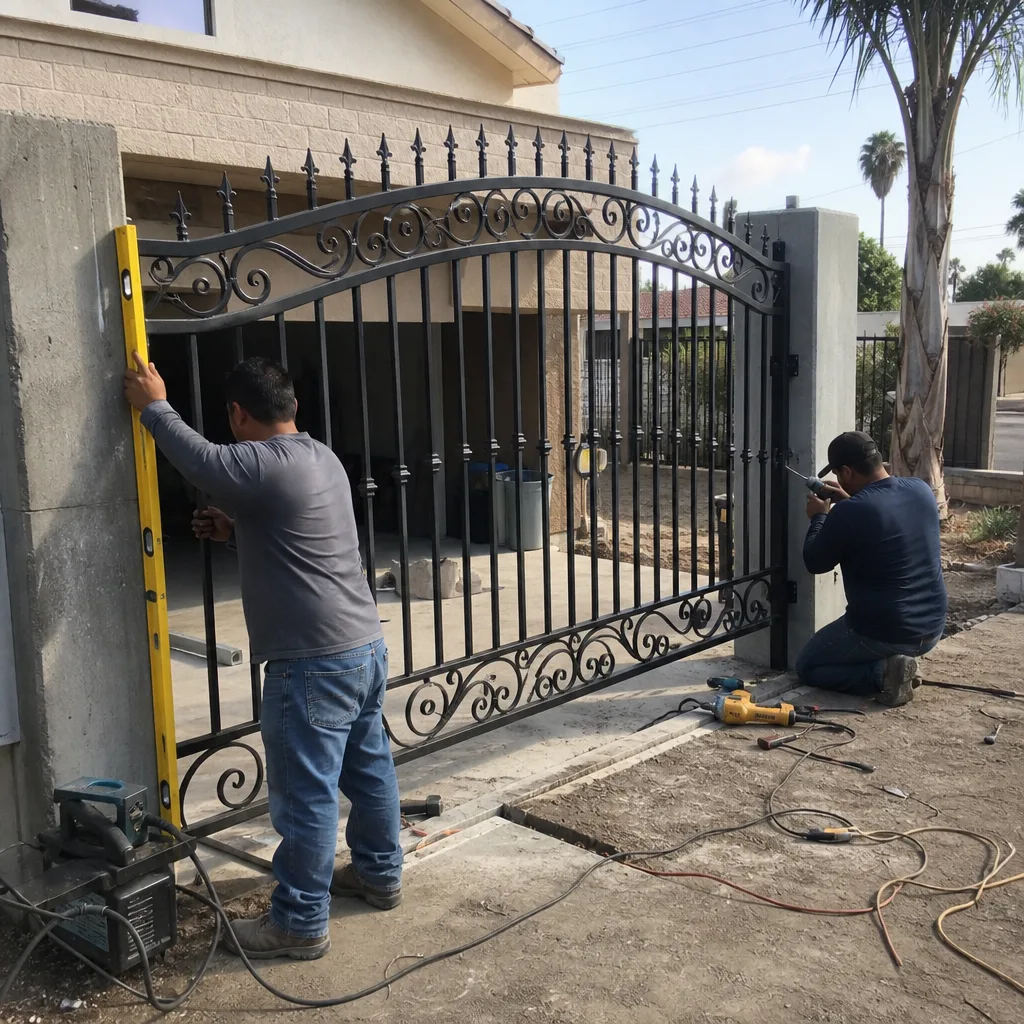
No, in almost every case, replacing a failed gate motor with an identical or like-for-like model using the existing wiring and mounting is classified as ordinary maintenance under the California Residential Code and requires no permit, including in the City of Anaheim. A permit becomes necessary only when the replacement motor is substantially different in voltage or current draw, changes the circuit, or is being added to a gate that was previously manual. If you are unsure whether your replacement counts as like-for-like, someone should read the old nameplate and the new nameplate side by side before the work starts. Call (657) 567-5799 for a free assessment in Anaheim.
In Anaheim, you need a building permit for any gate project that changes the structure or the powered equipment: adding an operator to a manual gate, changing the gate’s height or width, moving the gate to new posts, pouring new concrete footings, switching the swing direction, or installing a new gate where none existed. Routine part replacements and like-for-like repairs do not trigger permits. When in doubt, the City of Anaheim Building Division provides a permit determination service, or a licensed gate contractor can make the call in writing. See our guide on How to Hire a Gate Repair Contractor in Anaheim: A Step-by-Step Guide.
You can sell the home, but the unpermitted gate may become a disclosure issue during escrow if the buyer or buyer’s agent requests a building records search from the City of Anaheim. Many buyers condition the sale on a retroactive permit, which costs the same as the original permit but often requires stricter inspections and sometimes physical changes to the gate. If you know the gate is unpermitted, address it before listing; the cure is cheaper outside the closing window. Call (657) 567-5799 for a written evaluation.
UL 325 is the safety standard covering automated gate operators and their entrapment-protection requirements, and California enforces it through Title 24 and the National Electrical Code. It matters because every automated gate must have at least two independent entrapment-protection devices, and at least one must be an external sensor like a photo-eye or a contact edge at every pinch point. A residential gate that lacks these devices is code-noncompliant and creates a distinct liability exposure if someone is injured.
Most residential gate permits in the City of Anaheim clear plan review within one to two weeks, and the complete process from submission to final inspection typically lands between three and five weeks, depending on corrections, inspection scheduling, and whether the project involves new concrete footings that require a rough inspection before the pour. HOA review periods run in parallel and can extend the timeline depending on the association’s meeting cycle.
No, routine repair and like-for-like part replacement do not usually require HOA design review in Anaheim, because the gate’s appearance and footprint are not changing. HOA architectural approval typically applies when the gate’s material, color, height, or style changes, or when a new gate or operator is being added. When HOA standards and city code conflict, the stricter standard governs, and the city’s safety and setback requirements always take legal precedence. Call (657) 567-5799 for help navigating a specific Anaheim HOA’s rules.
The Bottom Line
California permit requirements for gate work are narrower than most homeowners assume: routine repair and like-for-like replacement need no permit, while adding an operator, changing dimensions, pouring footings, or building new gates almost always do. What most people miss is the documentation gap. An undocumented gate repair, however well executed, leaves the homeowner without the evidence an insurer, an HOA, or a future buyer will ask for. The safe path in Anaheim is the same in every scenario: a written scope, a written price, a photo record, and a clear statement of the permit status. None of that costs extra when the contractor already works that way.
Contact Vance Gate Repair Anaheim
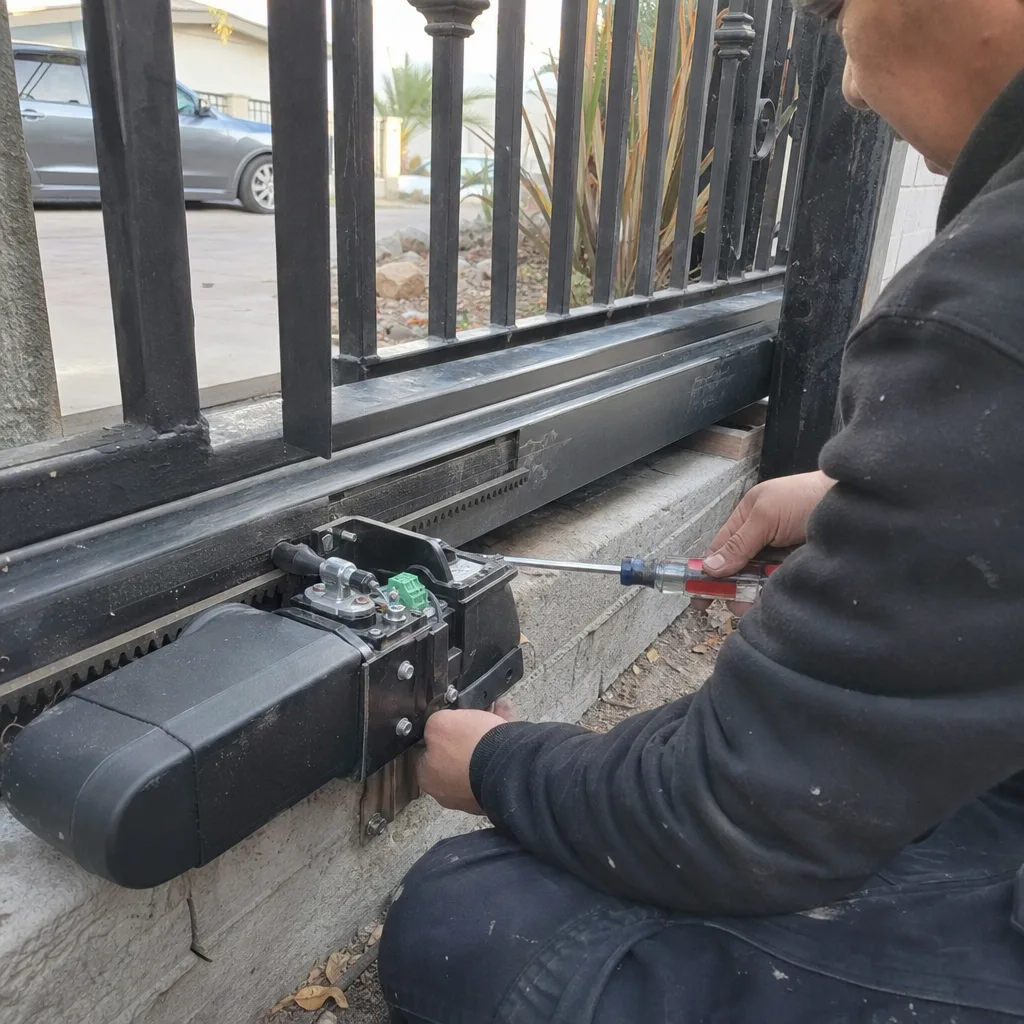
If you are planning a gate repair, replacement, or new installation in Anaheim and you want a clear written answer on permits, codes, and documentation before anyone starts work, call Vance Gate Repair Anaheim at (657) 567-5799. Explore more guides & resources on our blog. We provide free estimates, a written price before any work begins, and a documented photo record on every visit. You will know exactly what the job requires, what it costs, and what the permit picture looks like, before you make a decision.
Written by Adrian Vance, Owner at Vance Gate Repair Anaheim, serving Anaheim since 2014.